

"Whenever you find yourself on the side of the majority, it's time to pause and reflect"
Mark Twain
Have you ever asked yourself why so many of your peers look and sound the same? Across the domains of think tanks, foundations and advocacy groups there is huge divergence when it comes to things like leadership, core mission, key beneficiaries, policy goals.
And yet looking at their websites, you would think the opposite was true. Here you'll find remarkable convergence when it comes to how these organisations present themselves, and the story that they tell.
This probably shouldn't come as a surprise. It's only human to err on the side of caution. To find safety in numbers.
Plus, it’s easier to imitate what your peers are doing than to do something different (and easier to justify to the board, regardless of results). It's why most cause-led organisations end up sticking to the script instead of writing their own.
But what if sameness was actually the riskier option?
The sameness drag
The truth is that sameness comes with a price. You might not see it on the balance sheet, but sooner or later a lack of differentiation will start to hold your nonprofit back – and even drag it down.
Here's how sameness can hold back even the best expert nonprofit:
1) Low pride, low alignment
When it's not clear what you stand for – and how you're different – your people get restless. Pride in the organisation can start to dip. Alignment can be hard to find. After all, aren't we kind of all things to all people...?
2) Leader in the spotlight
When your brand isn't telling a memorable story, it’s left to the charismatic leader to fill in the gaps. And that means an over-reliance on one or two key people being on a stage or in a room before donors or other leaders catch the vision.
3) The IBM effect
When someone can't work out how your organisation is different, they'll resort to the default option: they'll choose IBM. And that's bad news for everyone except the big names in the sector.
The reality is that sameness acts as a drag at each stage of the audience's journey with your brand:
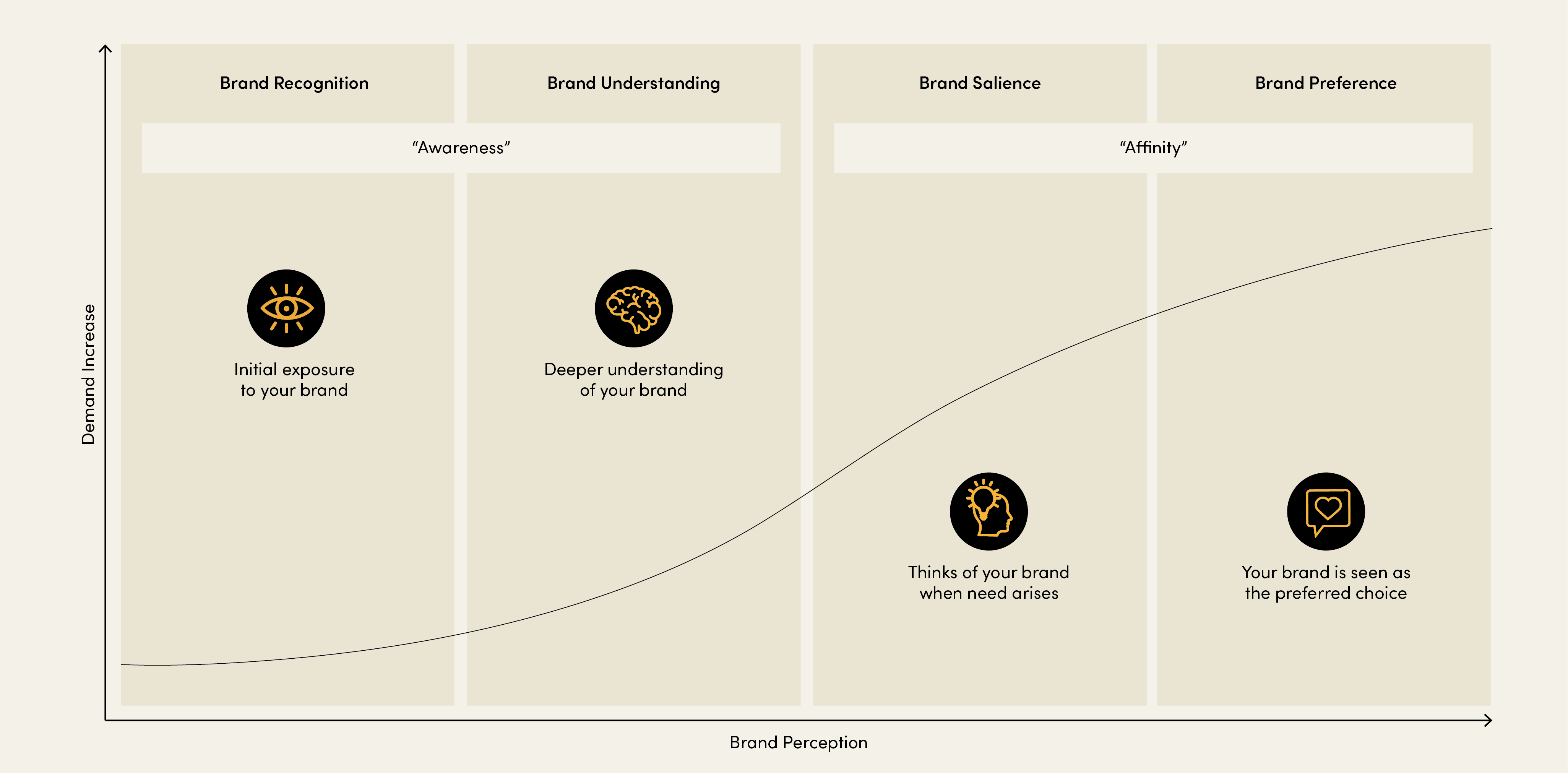
[Brand Recognition]
You become harder to spot in the crowd
[Brand Understanding]
You become less memorable after the introduction
[Brand Salience]
You aren't up top-of-mind in the internal conversations
[Brand Preference]
You end up being considered – but not chosen
So whether you're looking to bring in new board members, institutional donors, policymakers or other leaders – the job of your brand is to be meaningfully different from the alternatives.
Be more firefly
When it comes to your brand – the space you own, the story you tell – there are broadly two strategies you can pursue:
The moth strategy
Those who focus predominantly on the risks of being different will likely build a brand that:
- Follows the biggest light in the room (the market leader, “best practice”, etc)
- Behaves like other brands in the space
- Is hard to notice, and easy to ignore
This approach may not end in death – but requires a lot of flapping and circling, often for little reward.
The firefly strategy
Those who emphasise the gains of being different will likely build a brand that:
- Generates its own light (instead of being drawn to someone else’s)
- Follows a distinct path, gives off a unique signal
- Is easy to pick out from the crowd
It’s an approach that requires courage, for sure – but will also draw the eye and leave a lasting impression.
The bottom line
When it comes to differentiation, fortune really does favour the brave. In an in-depth study of over 10,000 global brands, Kantar identified difference as the single strongest predictor of brand growth, market share capture, and pricing power (ahead of other factors like awareness of size).
Across a global dataset of B2B brands, Kantar’s BrandZ study found:
- Perceived difference accounts for 48% of total pricing power – the biggest single factor
- Brands with high difference scores are 2x as likely to increase market share vs low difference peers
- Brands that are ‘meaningfully different’ achieve up to 5x higher market penetration compared with their generic competitors
Whilst this study may focus on private sector brands, it highlights an underlying truth: that differentiation isn’t really about being "less boring" or "more interesting". It's about bottom line realities like growth and income.
In short, it pays to be different.
The AI accelerant
In the past, the moth strategy of brand-building worked just fine. Expert organisations emphasised competence and conveyed professionalism. It was enough to separate them from those who couldn’t.
But AI has changed the game.
The production of quality outputs is no longer scarce or expensive. In fact, it has never been easier (or cheaper) to be clear and compelling. What used to be the hallmark of excellence is becoming the norm across websites, pitch decks and content pieces.
What’s worse, the tools we are using to keep pace are accelerating our drift into sameness. AI is a convergence machine, after all – built to find and reproduce the most acceptable response, the received wisdom, the safe middle ground. Left unchecked, it will offer the same answers and guide towards the same place – regardless of context.
And that makes sameness not just costly – but actively dangerous.
In an AI world, sounding like everyone else could end up being the riskiest move of all. Because the category norm is exactly what the machine produces. It’s the centre of gravity everyone is being pulled into.
The result is a landscape of non-profit brands that look competent, but not different. And in that environment, it does you little favour blending in with all the other competent moths.
Every organisation has a unique value at its heart, a unique space it can own, a unique story it can tell. Perhaps it’s time to fight the fear of being different – and replace it with something more useful:
The fear of being the same.


